Week 9: Hyperscale Architecture & Final Integration (Days 57-60)

What We Build
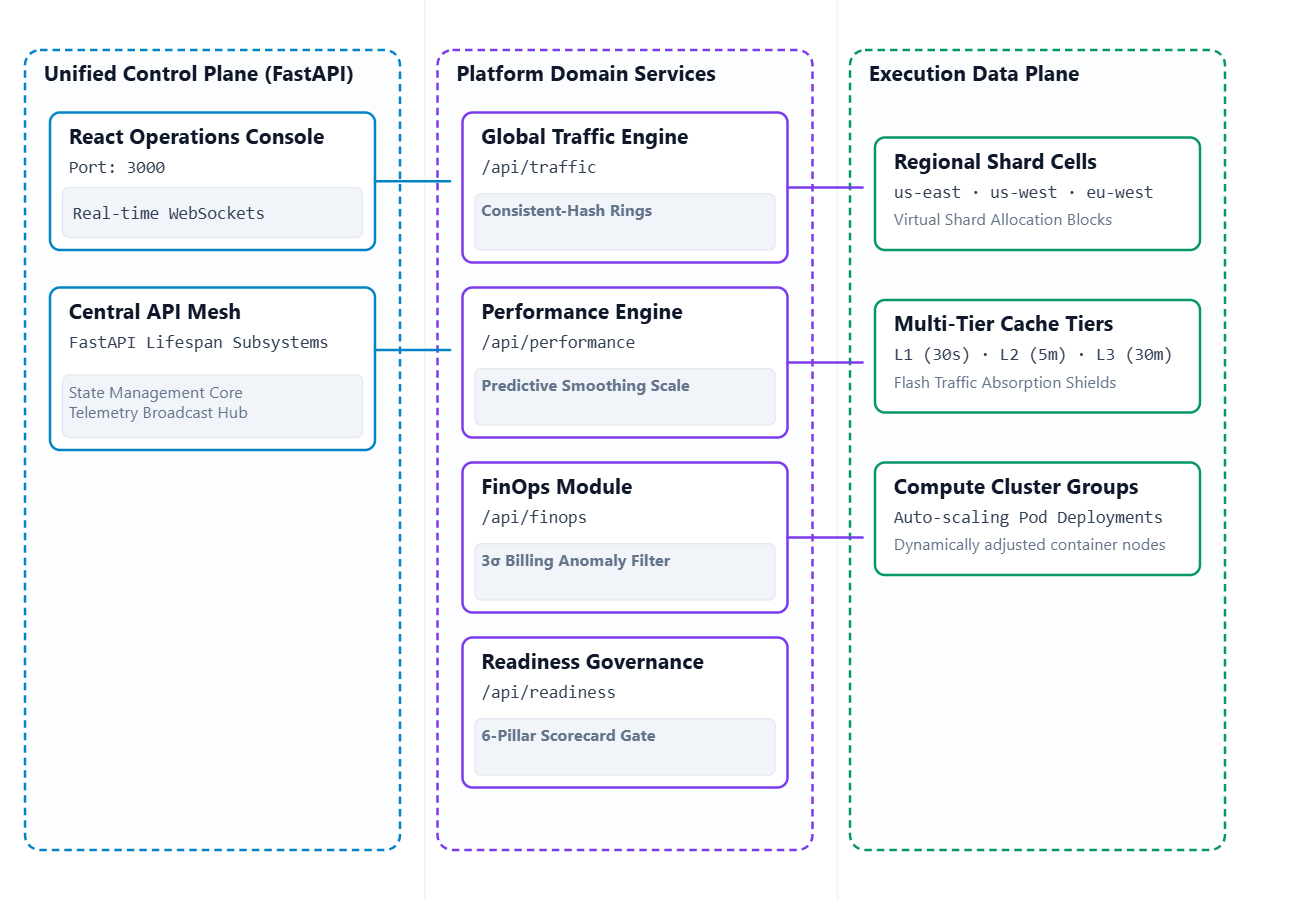
You will operate Atlas Hyperscale Platform — a single control plane that unifies global traffic engineering, predictive scaling, FinOps accountability, and production-readiness gates. When Netflix serves a global catalog or Shopify absorbs a flash-sale spike, no single team owns “the server.” They own loops: route traffic cheaply, scale before saturation, spend consciously, and gate launches with evidence. Atlas teaches that integration pattern in one repository.
The platform is built from scratch as one product: four domain routers share one FastAPI process, one React console, and one WebSocket broadcast. Traffic, performance, economics, and readiness are first-class modules — not separate repos glued at the UI.
Agenda
Traffic engineering — geographic routing, consistent-hash sharding, multi-tier cache, regional failover
Performance operations — profiling, predictive auto-scaling, query optimization, capacity runway
FinOps governance — namespace cost attribution, optimization recommendations, anomaly alerting
Production readiness — six-pillar validation, integration tests, runbooks, knowledge base
Unified console — live dashboard with cross-domain Run Platform Demo
Success criteria: Dashboard shows live metrics; validation returns six pillar scores; FinOps total cost updates after collection; failover reroutes traffic away from a failed region.
Why a Unified Control Plane Matters
In most organizations, traffic routing lives in CDN configs, scaling in a separate autoscaler service, cost in a spreadsheet, and launch approval in a wiki. Each layer works until something breaks at a boundary — a region fails but FinOps still bills it, autoscaler adds replicas after latency already spiked, or a service ships without a runbook.
Platform Placement
Atlas sits at the coordination layer between product traffic and raw cloud infrastructure — the same role internal platforms play at hyperscale retailers, social feeds, and fintech payment rails.
Atlas does not replace Kubernetes, cloud consoles, or observability backends. It exposes a stable internal API so a product team can request a user profile without knowing which region, shard, or cache tier served it — while SRE and platform teams retain policy control behind that abstraction.
Core Concepts by Engineering Discipline