
Week 2 : Policy-Driven Release Gate

What we build today
Python 3.11 release-gate API.
React/JavaScript release-console UI.
SecOps policy checks before promotion.
SRE metrics for gate quality.
End-to-end local + Docker verification.
This lesson is part of Hands On Devops Engineeirng and connects DevOps, SecOps, SRE, Cloud, Platform, Release, Automation, and Infrastructure Engineering through one practical build.
Week target and system placement
Week 2 target is CI/CD excellence. The release gate sits between “tests complete” and “deploy.” It converts release evidence into deterministic decisions:
ALLOWorDENY. This removes process drift and improves deployment safety.
Core concepts
DevOps
Use one release contract across services. No hidden team-specific logic in separate pipelines. Consistent contracts lower operational noise.
SecOps
Rules must return machine decisions and human reasons. Denial reasons should be short and actionable. Versioned policy files provide traceable governance.
SRE
Gate deny-rate and latency are reliability signals. Deny spikes often reveal ecosystem drift early. These metrics should be reviewed with deployment health.
Cloud / Platform / Release
Keep gate API stateless and policy files decoupled from UI. This enables independent scaling and safe policy rollback. Promotion automation stays stable while policies evolve.
Architecture, control flow, data flow, state changes
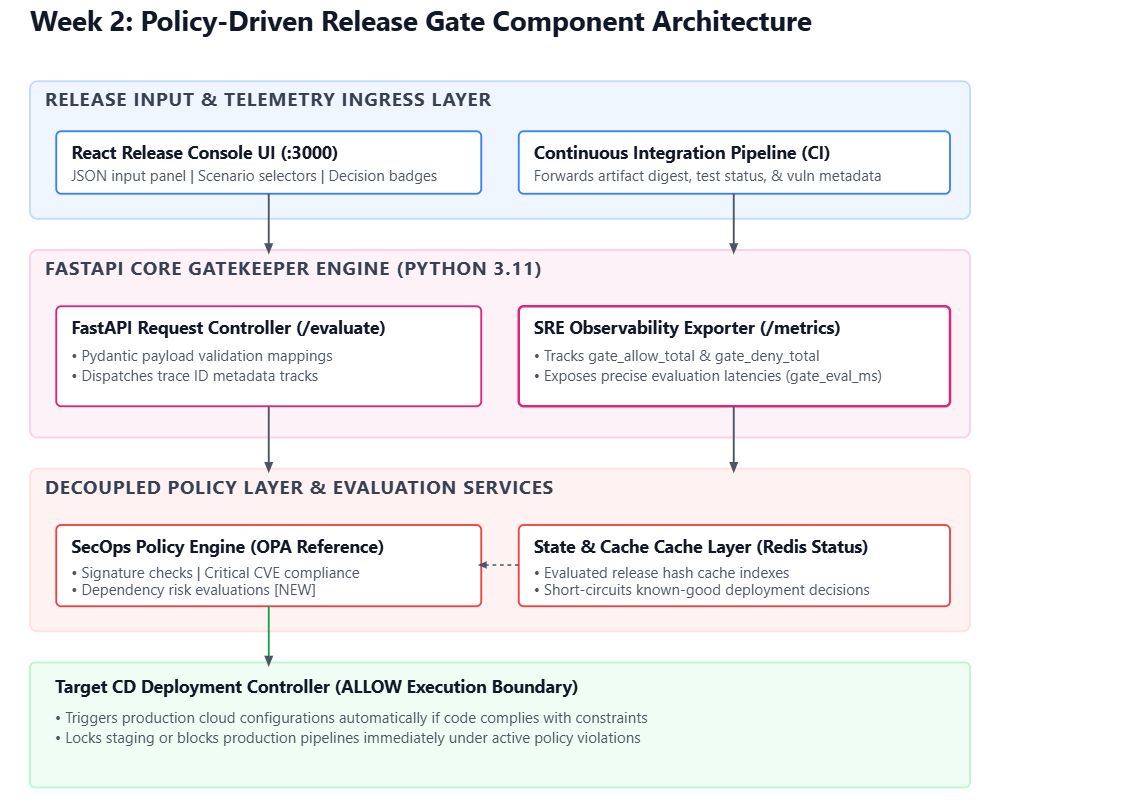
Architecture: CI -> Gate API -> Policy evaluator -> Decision -> Deployment controller.
Control flow: receive payload -> validate -> evaluate -> decide -> continue/stop deployment.
Data flow: artifact digest, signature flag, vuln counts, test status, target environment.
