
Hands-On DevOps Engineering: Production Ready - Detailed Curriculum

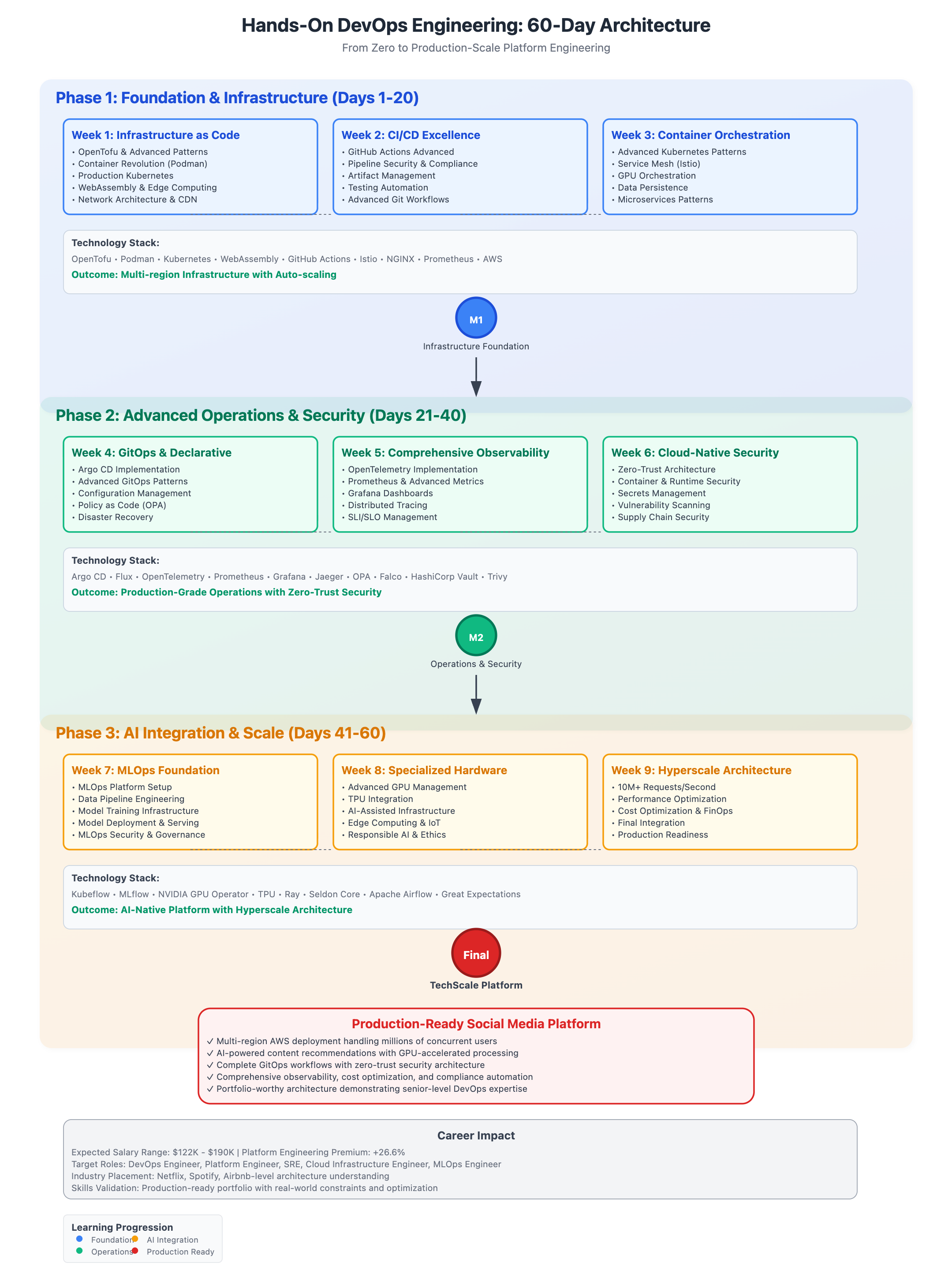
Detailed Curriculum
Phase 1: Foundation & Infrastructure (Days 1-20)
Week 1: Infrastructure as Code Mastery (Days 1-7)
Day 1: Modern Linux Systems & Cloud Foundation
Learning Objectives:
Configure production-grade Linux environments with performance tuning
Establish AWS account with proper IAM structure and security baselines
Implement cost allocation and billing optimization strategies
Topics:
Linux performance tuning for high-scale applications
AWS Well-Architected Framework implementation
IAM roles, policies, and cross-account access patterns
VPC design for microservices architectures
Cost allocation tags and billing optimization
Day 2: OpenTofu & Advanced Infrastructure Patterns
Learning Objectives:
Migrate from Terraform to OpenTofu with licensing considerations
Implement infrastructure state management and locking mechanisms
Design reusable infrastructure modules with dependency management
Topics:
OpenTofu vs Terraform: licensing implications and migration strategies
Remote state management with locking and versioning
Module composition and dependency management patterns
Infrastructure drift detection and automated remediation
Advanced resource lifecycle management
Day 3: Container Revolution - Beyond Docker
Learning Objectives:
Deploy Podman in production environments with performance benchmarking
Implement container security scanning and vulnerability management
Design multi-stage build optimizations for production workloads
Topics:
Podman vs Docker performance and security comparison
Container security scanning with Trivy and vulnerability management
Multi-architecture image building (ARM64/AMD64)
Container registry security and compliance
Rootless containers and security implications
Day 4: Kubernetes Production Deployment
Learning Objectives:
Deploy production-grade Kubernetes clusters with managed services
Implement cluster autoscaling and intelligent node management
Configure network policies and security contexts for zero-trust
Topics:
EKS cluster configuration with managed node groups
Cluster autoscaler and horizontal pod autoscaling strategies
Network policies for zero-trust architecture implementation
Resource quotas and limit ranges for cost control
Multi-tenancy patterns with vCluster and namespace isolation
Day 5: WebAssembly & Edge Computing Integration
Learning Objectives:
Deploy WebAssembly workloads on Kubernetes with runtime optimization
Implement edge computing patterns for ultra-low latency
Compare performance metrics: containers vs WASM vs traditional deployments
Topics:
WebAssembly runtime integration with containerd and cri-o
Edge computing deployment patterns and data synchronization
Cold start optimization techniques and performance tuning
WASM vs container performance analysis
Edge-to-cloud data synchronization strategies
Day 6: Advanced Storage & Database Patterns
Learning Objectives:
Design distributed storage architectures with high availability
Implement database sharding strategies for horizontal scaling
Configure automated backup and disaster recovery procedures
Topics:
Multi-region database replication and consistency patterns
Database connection pooling with PgBouncer and performance optimization
Automated backup strategies with point-in-time recovery
Database performance monitoring and query optimization
Storage cost optimization strategies
Day 7: Network Architecture & CDN Integration
Learning Objectives:
Design global network architectures with geographic routing
Implement CDN strategies for dynamic and static content delivery
Configure DNS optimization and failover strategies
Topics:
Global traffic routing and load balancing strategies
CDN configuration for optimal content delivery
DNS optimization, failover, and disaster recovery
Network security groups, NACLs, and traffic filtering
Data transfer cost optimization techniques
Week 2: CI/CD Pipeline Excellence (Days 8-14)
Day 8: GitHub Actions Advanced Patterns
Learning Objectives:
Build enterprise-grade CI/CD pipelines with reusable components
Implement pipeline security with OIDC and secrets management
Design matrix builds and parallel execution for optimization
Topics:
Reusable workflows and composite actions development
Advanced caching strategies for build optimization
Multi-environment deployment patterns and promotion strategies
Pipeline security with OIDC and short-lived tokens
Performance optimization and parallel job execution
Day 9: Pipeline Security & Compliance
Learning Objectives:
Implement comprehensive DevSecOps practices in CI/CD
Configure automated compliance validation and reporting
Design security scanning integration with quality gates
Topics:
Software Bill of Materials (SBOM) generation and management
Container vulnerability scanning with Grype and Trivy
Policy as Code implementation with Open Policy Agent
SOC2/ISO27001 compliance automation
Secret scanning, detection, and automated remediation
Day 10: Artifact Management & Registry Security
Learning Objectives:
Configure secure artifact repositories with access controls
Implement image signing and attestation with Sigstore
Design artifact promotion workflows across environments
Topics:
Container registry security with Harbor and access controls
Image signing with Cosign and Sigstore integration
Artifact attestation and provenance tracking
Registry vulnerability scanning and policy enforcement
Multi-registry replication and disaster recovery
Day 11: Testing Automation & Quality Gates
Learning Objectives:
Implement comprehensive testing strategies across the pyramid
Configure quality gates and deployment gates with metrics
Design performance testing automation and chaos engineering
Topics:
Test pyramid implementation (unit, integration, end-to-end)
Performance testing with K6 and realistic load generation
Chaos engineering integration with Chaos Monkey and Litmus
Quality gates with SonarQube and code coverage enforcement
Test data management and environment provisioning
Day 12: Multi-Environment Deployment Strategies
Learning Objectives:
Design promotion pipelines with automated gates across environments
Implement blue-green and canary deployment strategies
Configure environment-specific configurations and feature flags
Topics:
Environment promotion strategies and automated quality gates
Configuration management with environment-specific overrides
Feature flag integration for safe deployment practices
Rollback strategies and automated recovery procedures
Cost optimization for ephemeral and preview environments
Day 13: Performance Monitoring in Pipelines
Learning Objectives:
Implement comprehensive pipeline performance monitoring
Configure build optimization strategies and resource utilization
Design pipeline cost optimization and efficiency metrics
Topics:
Pipeline performance metrics collection and analysis
Build cache strategies and dependency optimization
CI/CD resource utilization monitoring and optimization
Cost analysis and optimization for CI/CD infrastructure
Pipeline reliability engineering and failure analysis
Day 14: Advanced Git Workflows & Branch Strategies
Learning Objectives:
Implement enterprise Git workflows for large development teams
Configure automated branch protection and merge strategies
Design dependency management and security automation
Topics:
Git workflow strategies for high-velocity development teams
Automated dependency updates with Dependabot and Renovate
Branch protection rules and required status checks
Merge queue strategies and automated conflict resolution
Git LFS implementation for large asset management
Week 3: Container Orchestration & Service Architecture (Days 15-21)
Day 15: Advanced Kubernetes Patterns
Learning Objectives:
Implement custom resource definitions (CRDs) and operators
Deploy automated application management with Kubernetes operators
Configure advanced scheduling, affinity, and resource management
Topics:
Custom Resource Definitions and controller implementation
Operator pattern development and lifecycle management
Pod disruption budgets and high availability strategies
Node affinity, anti-affinity, and advanced scheduling
Resource quotas, limit ranges, and capacity planning
Day 16: Service Mesh Introduction - Istio Deep Dive
Learning Objectives:
Deploy and configure Istio service mesh for production workloads
Implement advanced traffic management and security policies
Configure comprehensive observability for service mesh architecture
Topics:
Istio architecture, components, and production deployment
Traffic management with virtual services and destination rules
Security policies with mutual TLS and authentication
Observability integration with distributed tracing
Performance impact analysis and optimization strategies
Day 17: GPU Orchestration & Specialized Hardware
Learning Objectives:
Configure GPU-enabled Kubernetes nodes with NVIDIA operators
Implement GPU resource scheduling and sharing strategies
Deploy AI/ML workloads on specialized hardware with optimization
Topics:
NVIDIA GPU Operator installation and cluster configuration
GPU resource scheduling, sharing, and multi-instance GPU (MIG)
TPU integration with Google Kubernetes Engine
Cost optimization strategies for GPU workloads
Specialized hardware monitoring and performance tuning
Day 18: Data Persistence & StatefulSets
Learning Objectives:
Deploy stateful applications with StatefulSets and persistent storage
Configure automated backup and disaster recovery strategies
Implement distributed database patterns with operators
Topics:
StatefulSet deployment patterns and persistent volume management
Database operators for PostgreSQL, MongoDB, and Cassandra
Backup automation with Velero and cross-region replication
Storage class optimization and cost management
Data consistency patterns for distributed systems
Day 19: Ingress & Load Balancing Strategies
Learning Objectives:
Configure advanced ingress controllers with global load balancing
Implement SSL/TLS automation and certificate management
Design rate limiting and DDoS protection strategies
Topics:
Ingress controller comparison and selection (NGINX, Traefik, Envoy)
SSL certificate automation with cert-manager and Let's Encrypt
Rate limiting, DDoS protection, and traffic shaping
Global load balancing with cloud provider integration
Cost optimization for ingress and load balancing
Day 20: Microservices Communication Patterns
Learning Objectives:
Implement synchronous and asynchronous communication patterns
Configure service discovery and circuit breaker strategies
Design event-driven architectures with message queues
Topics:
Service-to-service communication patterns and best practices
Event sourcing and CQRS implementation strategies
Circuit breaker patterns with resilience libraries
Message queue integration with Kafka and RabbitMQ
Distributed transaction patterns and saga implementation
Day 21: Phase 1 Integration & Assessment
Learning Objectives:
Integrate all Phase 1 components into cohesive architecture
Perform comprehensive load testing and performance optimization
Document infrastructure architecture and operational procedures
Topics:
End-to-end infrastructure validation and testing
Load testing with realistic traffic patterns and scenarios
Performance optimization and bottleneck identification
Infrastructure documentation and runbook creation
Cost analysis and optimization recommendations
Phase 2: Advanced Operations & Security (Days 22-40)
Week 4: GitOps & Declarative Operations (Days 22-28)
Day 22: GitOps Fundamentals with Argo CD
Learning Objectives:
Deploy Argo CD for GitOps-based application delivery
Implement declarative application management and sync strategies
Configure multi-environment GitOps workflows
Topics:
GitOps principles and implementation patterns
Argo CD installation, configuration, and cluster management
Application sync strategies and health checks
Multi-environment promotion workflows
GitOps security and access control
Day 23: Advanced GitOps Patterns
Learning Objectives:
Implement app-of-apps pattern for scalable GitOps
Configure ApplicationSets for dynamic application management
Design progressive delivery with GitOps integration
Topics:
App-of-apps pattern and ApplicationSets configuration
Dynamic application generation and template management
Progressive delivery integration with Argo Rollouts
Multi-cluster GitOps management strategies
GitOps workflow automation and CI integration
Day 24: Configuration Management & Secrets
Learning Objectives:
Implement external secrets management with GitOps
Configure sealed secrets and external secrets operators
Design configuration drift detection and remediation
Topics:
External Secrets Operator integration with cloud providers
Sealed Secrets implementation and key management
Configuration drift detection and automated remediation
GitOps secrets management best practices
Compliance and audit trail for configuration changes
Day 25: Policy as Code Implementation
Learning Objectives:
Deploy Open Policy Agent (OPA) for policy enforcement
Implement Gatekeeper for admission control policies
Configure policy violation monitoring and remediation
Topics:
Open Policy Agent deployment and policy development
Gatekeeper installation and constraint template creation
Policy violation monitoring and automated remediation
Compliance policy automation (PCI, SOX, GDPR)
Policy testing and validation strategies
Day 26: Infrastructure GitOps with Crossplane
Learning Objectives:
Deploy Crossplane for infrastructure GitOps
Implement composite resources and infrastructure abstractions
Configure cloud provider integration and policy enforcement
Topics:
Crossplane architecture and provider configuration
Composite resource definitions and infrastructure abstractions
Cloud provider integration (AWS, Azure, GCP)
Infrastructure policy enforcement and compliance
Cost optimization through infrastructure lifecycle management
Day 27: Disaster Recovery & Business Continuity
Learning Objectives:
Design comprehensive disaster recovery strategies
Implement automated backup and restore procedures
Configure cross-region failover and data synchronization
Topics:
Disaster recovery planning and RTO/RPO objectives
Automated backup strategies with Velero and cloud-native tools
Cross-region replication and failover automation
Database disaster recovery and point-in-time restoration
Business continuity testing and validation procedures
Day 28: GitOps Observability & Monitoring
Learning Objectives:
Implement comprehensive GitOps monitoring and alerting
Configure application health monitoring and SLI/SLO tracking
Design GitOps performance optimization strategies
Topics:
GitOps deployment monitoring and health checks
Application performance monitoring integration
SLI/SLO definition and tracking for GitOps workflows
GitOps performance optimization and scaling strategies
Incident response automation for GitOps failures
Week 5: Comprehensive Observability (Days 29-35)
Day 29: OpenTelemetry Implementation
Learning Objectives:
Deploy OpenTelemetry collectors and instrumentation
Implement distributed tracing across microservices
Configure metrics and logs collection with OpenTelemetry
Topics:
OpenTelemetry architecture and component deployment
Auto-instrumentation for popular programming languages
Distributed tracing implementation and correlation
Metrics collection and custom instrumentation
Logs collection and structured logging practices
Day 30: Prometheus & Advanced Metrics
Learning Objectives:
Deploy Prometheus with high availability configuration
Implement custom metrics and alerting rules
Configure long-term metrics storage and federation
Topics:
Prometheus high availability and clustering setup
Custom metrics development and instrumentation
PromQL advanced queries and alerting rule creation
Long-term storage with Thanos and Cortex
Prometheus federation and multi-cluster monitoring
Day 31: Grafana Dashboards & Visualization
Learning Objectives:
Create comprehensive monitoring dashboards with Grafana
Implement automated dashboard provisioning and management
Configure advanced visualization and alerting integration
Topics:
Grafana dashboard development and template management
Automated dashboard provisioning with GitOps
Advanced visualization techniques and panel configuration
Grafana alerting integration with notification channels
Dashboard sharing and access control management
Day 32: Log Management & Analysis
Learning Objectives:
Deploy centralized logging with ELK or EFK stack
Implement log aggregation and structured logging practices
Configure log analysis and anomaly detection
Topics:
ELK/EFK stack deployment and configuration
Log aggregation strategies and shipping optimization
Structured logging implementation and parsing
Log analysis with machine learning and anomaly detection
Log retention policies and cost optimization
Day 33: Distributed Tracing & APM
Learning Objectives:
Implement distributed tracing with Jaeger or Zipkin
Configure application performance monitoring integration
Design trace sampling and optimization strategies
Topics:
Jaeger deployment and trace collection configuration
Distributed tracing implementation across service boundaries
APM integration and performance bottleneck identification
Trace sampling strategies and cost optimization
Trace analysis and performance optimization techniques
Day 34: SLI/SLO & Error Budget Management
Learning Objectives:
Define comprehensive SLIs and SLOs for services
Implement error budget tracking and burn rate monitoring
Configure SLO-based alerting and incident response
Topics:
SLI/SLO definition and measurement strategies
Error budget calculation and burn rate monitoring
SLO-based alerting and escalation procedures
Incident response automation based on error budgets
SLO reporting and stakeholder communication
Day 35: Observability Cost Optimization
Learning Objectives:
Implement observability cost optimization strategies
Configure intelligent sampling and data retention policies
Design cost-aware monitoring and alerting systems
Topics:
Observability cost analysis and optimization techniques
Intelligent sampling strategies for traces and metrics
Data retention policies and lifecycle management
Cost-aware alerting and notification strategies
Observability ROI measurement and optimization
Week 6: Cloud-Native Security (DevSecOps) (Days 36-42)
Day 36: Zero-Trust Architecture Implementation
Learning Objectives:
Design zero-trust network architecture for Kubernetes
Implement identity-based access controls and policies
Configure network segmentation and micro-segmentation
Topics:
Zero-trust architecture principles and implementation
Identity and access management with OIDC and RBAC
Network policies and micro-segmentation strategies
Certificate management and mutual TLS implementation
Policy-based access control with OPA integration
Day 37: Container & Runtime Security
Learning Objectives:
Implement comprehensive container security scanning
Configure runtime security monitoring and protection
Deploy admission controllers for security policy enforcement
Topics:
Container image vulnerability scanning and policy enforcement
Runtime security with Falco and behavioral monitoring
Admission controller deployment for security policies
Container runtime security with gVisor and Kata Containers
Security benchmarking with CIS Kubernetes Benchmark
Day 38: Secrets Management & Encryption
Learning Objectives:
Deploy enterprise secrets management solutions
Implement encryption at rest and in transit
Configure automated secret rotation and lifecycle management
Topics:
HashiCorp Vault deployment and integration
Kubernetes secrets encryption and external secrets operators
Certificate management with cert-manager and PKI
Secret rotation automation and lifecycle policies
Compliance and audit requirements for secrets management
Day 39: Security Scanning & Vulnerability Management
Learning Objectives:
Implement comprehensive vulnerability scanning pipelines
Configure security policy enforcement and compliance automation
Design vulnerability management and remediation workflows
Topics:
SAST/DAST integration in CI/CD pipelines
Container and infrastructure vulnerability scanning
Compliance automation for regulatory requirements
Vulnerability management workflows and prioritization
Security metrics and reporting for compliance
Day 40: Incident Response & Security Monitoring
Learning Objectives:
Design security incident response procedures
Implement security monitoring and threat detection
Configure automated response and remediation workflows
Topics:
Security incident response planning and automation
SIEM integration and threat detection strategies
Automated security response and remediation workflows
Forensics and audit trail management
Security metrics and continuous improvement
Day 41: Supply Chain Security
Learning Objectives:
Implement software supply chain security controls
Configure SBOM generation and vulnerability tracking
Design secure software delivery pipelines
Topics:
Software Bill of Materials (SBOM) generation and management
Supply chain security controls and verification
Secure software delivery with Sigstore and attestation
Dependency vulnerability management and policies
Third-party component security and licensing compliance
Day 42: Phase 2 Integration & Security Assessment
Learning Objectives:
Integrate all Phase 2 security and operational components
Perform comprehensive security assessment and penetration testing
Document security architecture and incident response procedures
Topics:
End-to-end security validation and assessment
Penetration testing and vulnerability assessment
Security architecture documentation and procedures
Incident response playbook development
Compliance validation and audit preparation
Phase 3: AI Integration & Scale (Days 43-60)
Week 7: MLOps Foundation (Days 43-49)
Day 43: MLOps Platform Setup
Learning Objectives:
Deploy comprehensive MLOps platform with Kubeflow or MLflow
Configure experiment tracking and model versioning
Implement ML pipeline orchestration and automation
Topics:
MLOps platform architecture and component deployment
Experiment tracking with MLflow and model registry
ML pipeline orchestration with Kubeflow Pipelines
Model versioning and artifact management
ML development environment setup and configuration
Day 44: Data Pipeline Engineering
Learning Objectives:
Design and implement data pipelines for ML workloads
Configure data validation and quality monitoring
Implement data versioning and lineage tracking
Topics:
Data pipeline design patterns for ML workloads
ETL/ELT implementation with Apache Airflow
Data validation and quality monitoring with Great Expectations
Data versioning with DVC and lineage tracking
Stream processing with Kafka and Apache Flink
Day 45: Model Training Infrastructure
Learning Objectives:
Configure distributed training infrastructure with GPUs
Implement hyperparameter tuning and optimization
Design training job scheduling and resource management
Topics:
Distributed training with PyTorch and TensorFlow
GPU cluster configuration and resource scheduling
Hyperparameter tuning with Optuna and Ray Tune
Training job orchestration and resource optimization
Model checkpointing and training resumption strategies
Day 46: Model Deployment & Serving
Learning Objectives:
Deploy models with Seldon Core or KServe
Implement A/B testing for model performance comparison
Configure model serving optimization and scaling
Topics:
Model serving platforms comparison (Seldon, KServe, TorchServe)
Model deployment patterns and serving optimization
A/B testing frameworks for model comparison
Model serving scaling and resource optimization
Inference optimization with model quantization and distillation
Day 47: Model Monitoring & Observability
Learning Objectives:
Implement comprehensive model monitoring and drift detection
Configure model performance tracking and alerting
Design model explainability and fairness monitoring
Topics:
Model drift detection and data quality monitoring
Model performance metrics tracking and alerting
Model explainability with SHAP and LIME integration
Fairness monitoring and bias detection
Model observability integration with existing monitoring stack
Day 48: MLOps Security & Governance
Learning Objectives:
Implement ML model security and access controls
Configure model governance and compliance frameworks
Design responsible AI practices and ethical guidelines
Topics:
ML model security and adversarial attack protection
Model governance frameworks and approval workflows
Responsible AI implementation and bias mitigation
ML compliance and regulatory requirements
Model audit trails and explainability requirements
Day 49: MLOps Cost Optimization
Learning Objectives:
Implement cost optimization strategies for ML workloads
Configure resource scheduling and auto-scaling for training
Design cost-aware model serving and inference optimization
Topics:
ML workload cost analysis and optimization
Spot instance usage for training workloads
Model serving cost optimization and inference scaling
Resource scheduling optimization for training jobs
MLOps ROI measurement and cost allocation
Week 8: Specialized Hardware & AI-Assisted Operations (Days 50-56)
Day 50: Advanced GPU Management
Learning Objectives:
Configure advanced GPU sharing and multi-tenancy
Implement GPU monitoring and resource optimization
Design cost-effective GPU workload scheduling
Topics:
Multi-Instance GPU (MIG) configuration and management
GPU sharing strategies and resource isolation
GPU monitoring with NVIDIA DCGM and Prometheus
Cost optimization for GPU workloads and scheduling
GPU cluster scaling and auto-provisioning
Day 51: TPU Integration & Optimization
Learning Objectives:
Deploy TPU workloads on Google Kubernetes Engine
Implement TPU-optimized training and inference pipelines
Configure TPU cost optimization and scheduling strategies
Topics:
TPU architecture and workload optimization
GKE TPU node pools and resource management
TPU-optimized model training with JAX and TensorFlow
TPU cost optimization and preemptible instance usage
TPU performance monitoring and optimization
Day 52: AI-Assisted Infrastructure Management
Learning Objectives:
Implement AI-powered infrastructure optimization
Configure predictive scaling and resource management
Design intelligent automation with machine learning
Topics:
AI-powered infrastructure optimization and predictive analytics
Predictive auto-scaling with machine learning models
Intelligent resource scheduling and workload optimization
Anomaly detection for infrastructure monitoring
AI-assisted incident response and root cause analysis
Day 53: Edge Computing & IoT Integration
Learning Objectives:
Deploy edge computing infrastructure for AI workloads
Implement edge-to-cloud synchronization and management
Configure edge AI model deployment and optimization
Topics:
Edge computing architecture and deployment strategies
Edge Kubernetes distributions (K3s, MicroK8s, OpenYurt)
Edge AI model deployment and inference optimization
Edge-to-cloud data synchronization and management
Edge device management and fleet operations
Day 54: AI-Powered DevOps Tools
Learning Objectives:
Integrate AI-powered tools into DevOps workflows
Implement intelligent code analysis and automation
Configure AI-assisted monitoring and alerting systems
Topics:
GitHub Copilot integration for infrastructure code
AI-powered code review and quality analysis
Intelligent log analysis and anomaly detection
AI-assisted incident management and resolution
Automated documentation generation with AI tools
Day 55: Responsible AI & Ethics Implementation
Learning Objectives:
Implement ethical AI frameworks and governance
Configure bias detection and fairness monitoring
Design responsible AI deployment practices
Topics:
Ethical AI frameworks and implementation guidelines
Bias detection and fairness monitoring systems
Responsible AI deployment and governance processes
AI explainability and transparency requirements
AI ethics committee setup and decision-making processes
Day 56: Advanced Automation & Orchestration
Learning Objectives:
Design comprehensive automation frameworks
Implement intelligent workflow orchestration
Configure self-healing and autonomous operations
Topics:
Advanced automation frameworks and orchestration patterns
Self-healing infrastructure and autonomous operations
Intelligent workflow orchestration with AI integration
Chaos engineering automation and resilience testing
Autonomous incident response and recovery systems
Week 9: Hyperscale Architecture & Final Integration (Days 57-60)
Day 57: Hyperscale Architecture Patterns
Learning Objectives:
Design architecture for 10M+ requests per second
Implement global load balancing and traffic management
Configure multi-region deployment and failover strategies
Topics:
Hyperscale architecture patterns and design principles
Global load balancing and intelligent traffic routing
Multi-region deployment strategies and data consistency
CDN integration and edge computing optimization
Database sharding and distributed data management
Day 58: Performance Optimization & Scaling
Learning Objectives:
Implement comprehensive performance optimization strategies
Configure intelligent auto-scaling and resource management
Design capacity planning and growth management systems
Topics:
Application performance optimization and profiling
Database performance tuning and query optimization
Intelligent auto-scaling with predictive algorithms
Capacity planning and growth projection modeling
Performance testing and load generation strategies
Day 59: Cost Optimization & FinOps
Learning Objectives:
Implement comprehensive cost optimization strategies
Configure FinOps practices and cost accountability
Design cost-aware architecture and resource management
Topics:
Comprehensive cost analysis and optimization techniques
FinOps implementation and cost accountability frameworks
Reserved instance optimization and commitment management
Cost allocation and chargeback implementation
ROI measurement and cost-benefit analysis
Day 60: Final Integration & Production Readiness
Learning Objectives:
Complete end-to-end platform integration and validation
Perform comprehensive production readiness assessment
Document operational procedures and knowledge transfer
Topics:
Complete platform integration and end-to-end testing
Production readiness checklist and validation procedures
Operational runbook creation and knowledge documentation
Team training and knowledge transfer preparation
Post-deployment monitoring and continuous improvement planning
Assessment & Certification
Daily Assessments
Hands-on implementation exercises
Code review and architecture validation
Performance and security testing
Weekly Projects
Progressive platform development milestones
Integration testing and validation
Peer review and feedback sessions
Final Capstone
Complete TechScale platform deployment
Load testing and performance validation
Security assessment and compliance audit
Cost optimization and ROI analysis
Presentation to industry experts
Certification Requirements
95% attendance and daily completion rate
Successful weekly project deliveries
Passing scores on security and compliance assessments
Completed capstone project with production deployment
Peer review and mentor validation