The Abstraction Trap
Here’s how this gets built at 90% of shops that discover “differential privacy” exists: someone finds a Python DP library — usually a wrapper around IBM’s
diffprivlibor Google’sdifferential-privacy— and bolts it onto the trends endpoint as a subprocess call or a sidecar RPC. Every request that asks “what’s trending for tenant X” spins up a noise computation: import the library, instantiate a Laplace mechanism object with some hardcoded epsilon, sample noise, return.This passes code review. It even passes a load test at 50 RPS. It falls over at 50,000 RPS across 10,000 tenants, and it falls over in two distinct ways that most engineers never diagnose correctly because the symptoms look like “the database is slow.”
The first failure isn’t a resource limit — it’s a security failure. Naive per-request noise generation with no cross-request bookkeeping is vulnerable to a composition attack: query the same statistic N times, average the noised results, and the noise cancels out while the true value converges. Differential privacy isn’t a property of a single response; it’s a property of a budget (epsilon) that must be debited atomically across the full query history of a tenant. If your architecture treats each request as independent, you have not built differential privacy — you’ve built decoration.
The second failure is the one that shows up in your dashboards as p99 latency creep: per-request initialization of a Laplace/Gaussian sampler in an interpreted runtime pulls in a fresh heap allocation, a fresh CSPRNG seed syscall (
getrandom(2)), and — if you’re running this behind a GIL-bound service — full serialization of every noise computation onto one core while 31 others sit idle.
Quantifying the Failure Modes
Three concrete, measurable pathologies emerge from the naive design, and you should be able to name the syscall or scheduler mechanism behind each one:
Epsilon exhaustion via composition attack. With a naive per-request epsilon of 0.5 and no ledger, an attacker issuing 40 identical queries against a Laplace-noised count can recover the true value within roughly 3% error (variance of the mean of N Laplace(b) samples shrinks as
2b²/N). Your “privacy-preserving” endpoint becomes a slow oracle.
getrandom(2)syscall storms. Every fresh CSPRNG instantiation in a naive per-request handler issues at least onegetrandomsyscall for entropy. At 50K RPS this is 50K syscalls/sec purely for randomness sourcing — each one a full user/kernel mode transition (roughly 300-700ns of pure overhead before you’ve sampled a single noise value), invisible in application-level tracing because it never shows up as “your code,” it shows up as unexplained kernel time inperf top.CFS scheduler thrashing under GIL contention. When noise generation is serialized behind a language-level lock (CPython’s GIL is the canonical case, but any actor-per-tenant model with a shared mutex behaves identically), the Completely Fair Scheduler is handed dozens of runnable threads that immediately block on the same lock. You get high context-switch counts (
vmstatcscolumn climbing into the hundreds of thousands/sec) with low actual CPU utilization — the classic “CPU is idle but latency is terrible” signature that sends junior engineers chasing database indexes for a week.
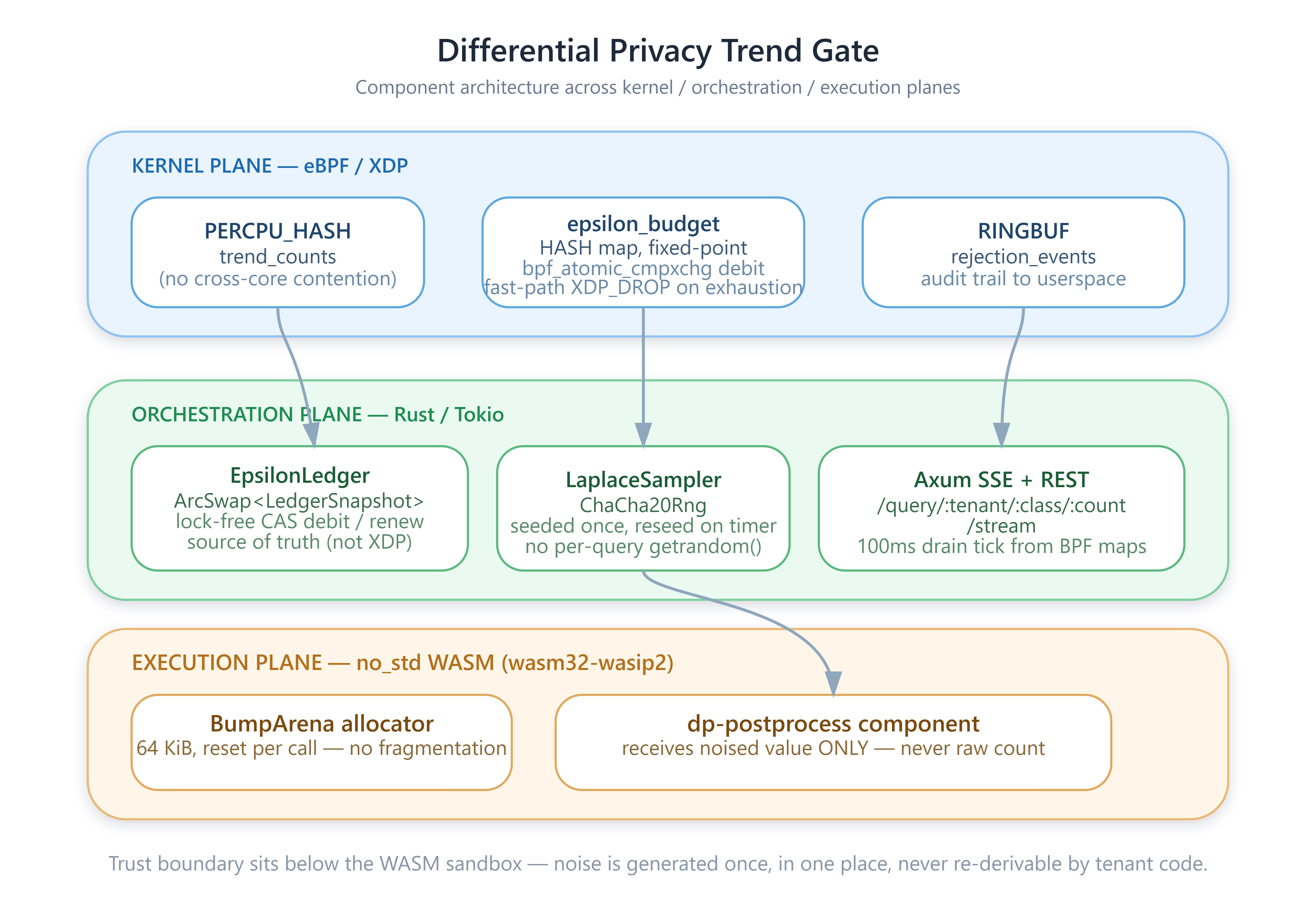
The NexusCore Architecture