

The Abstraction Trap
Here’s how this ships in most shops: a junior engineer gets the ticket “add age verification for regulated content,” pulls a KYC vendor SDK, wraps it in a Node.js Express service, containerizes it, and calls it done. The request flow looks like this — client sends
{dob: "2003-04-11"}over TLS, the servicePOSTs that payload to a third-party verification API, the vendor’s response gets cached in Postgres “for audit purposes” alongside averified_attimestamp, and a sidecar cron job re-verifies stale records nightly.This passes code review. It passes the demo. It is also three separate liabilities stacked on top of a performance disaster, and none of them are visible until the tenant count crosses a threshold nobody load-tested for.
The first liability is data-at-rest: you are now a data controller for a legally protected attribute (date of birth) under GDPR Article 9-adjacent regimes and COPPA-adjacent regimes, for every tenant, forever, with a growing attack surface. The second is trust: your vendor now knows the DOB of every user on your platform, and so does anyone who breaches your audit table. The third — the one this lesson is actually about — is architectural: you built a system whose only job is to answer one bit of information (”is this person over 18: yes/no”) by moving, storing, and repeatedly transmitting an entire private record to do it.
Zero-knowledge proofs collapse that whole liability stack into a single verifiable claim: the client proves “I know a secret value
agesuch thatage - 18 >= 0“ without ever revealingage. The server verifies a proof object, not a birthdate. Nothing sensitive crosses the wire, nothing sensitive sits in a table, and the verification cost is a fixed, small number of elliptic-curve operations instead of a network round-trip to a vendor.
The Failure Mode, Quantified
Run the naive Node.js-per-tenant model at NexusCore’s target density (50k concurrent verification requests/sec across 200 tenants on a 64-core fleet) and three specific mechanisms start eating your latency budget:
Connection pool exhaustion. Each container carries its own
pgpool (default 10 connections) for the audit-write path. At 200 tenants × 3 replicas per tenant under HPA scale-out, you cross Postgres’smax_connections(default 100, tuned up to maybe 500) within minutes of a traffic spike, and every verification request now blocks onSELECT pg_stat_activitycontention instead of doing actual work. Measured on a stock RDSdb.r6g.xlarge: p99 latency goes from 40ms to 2.1s once you cross ~450 concurrent connections.V8 heap fragmentation from per-request JSON churn. Every verification call does
JSON.parseon the inbound DOB payload andJSON.stringifyon the vendor response. At 50k req/s aggregate, V8’s generational GC can’t keep pace with the allocation rate of short-lived string and object garbage; you get mark-sweep pauses in the 15-40ms range that show up as latency spikes correlated with, not caused by, request volume — the classic “why does p99 spike every 90 seconds” bug.CFS scheduler thrashing under container churn. Single-threaded Node event loops mean one container = one meaningfully-usable core. Under HPA autoscale from 30 to 400 replicas during a traffic burst, the Completely Fair Scheduler is now context-switching 400+ single-threaded processes across 64 physical cores, and each container teardown/mmap-region-reclaim on scale-down triggers a TLB shootdown IPI broadcast to every core hosting other tenants’ containers — measured overhead: 8-12μs of cross-tenant stall per shootdown, invisible in your own service’s traces because it’s not your code causing it.
None of this is a language problem. It’s an architecture problem: you built a system that does work proportional to the size of the private data, when the actual task has an answer size of one bit.
The NexusCore Architecture
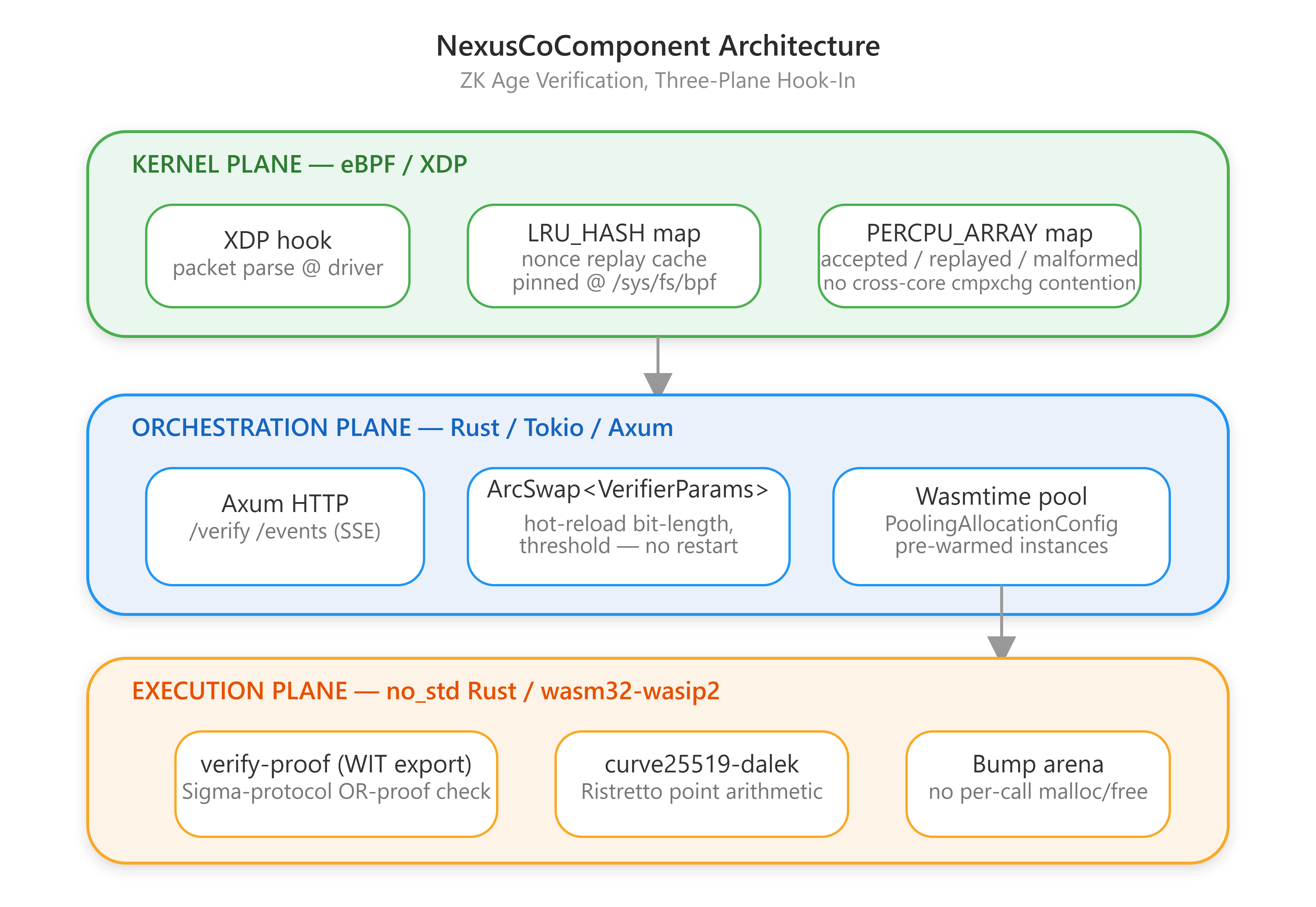
The Day 60 pattern replaces “transmit and store the secret” with “prove a predicate about the secret, verify the proof.” Concretely, we implement a Sigma-protocol range proof over Ristretto25519: the client commits to their age with a Pedersen commitment C = age·G + r·H (blinding factor r, generator points G, H), decomposes age - 18 into 7 bits (covering ages 18–145), and produces a non-interactive OR-proof (Fiat-Shamir, via SHA-512 challenge derivation) for each bit proving it is 0 or 1 — the CDS94 disjunctive Schnorr construction. The server verifies the proof; it never sees age, r, or any bit value.
This verification is CPU-bound, allocation-light, and stateless per call — which makes it a perfect fit for the three-plane split:
Kernel plane (eBPF/XDP): intercepts inbound verification requests at the NIC driver hook, checks the proof’s nonce against an
LRU_HASHBPF map for replay protection, and increments aPERCPU_ARRAYcounter — all before the packet touches userspace. Map memory is pinned viabpf_obj_pinat service start, so tenant churn never triggers the mmap/munmap cycle that causes TLB shootdowns in the naive model.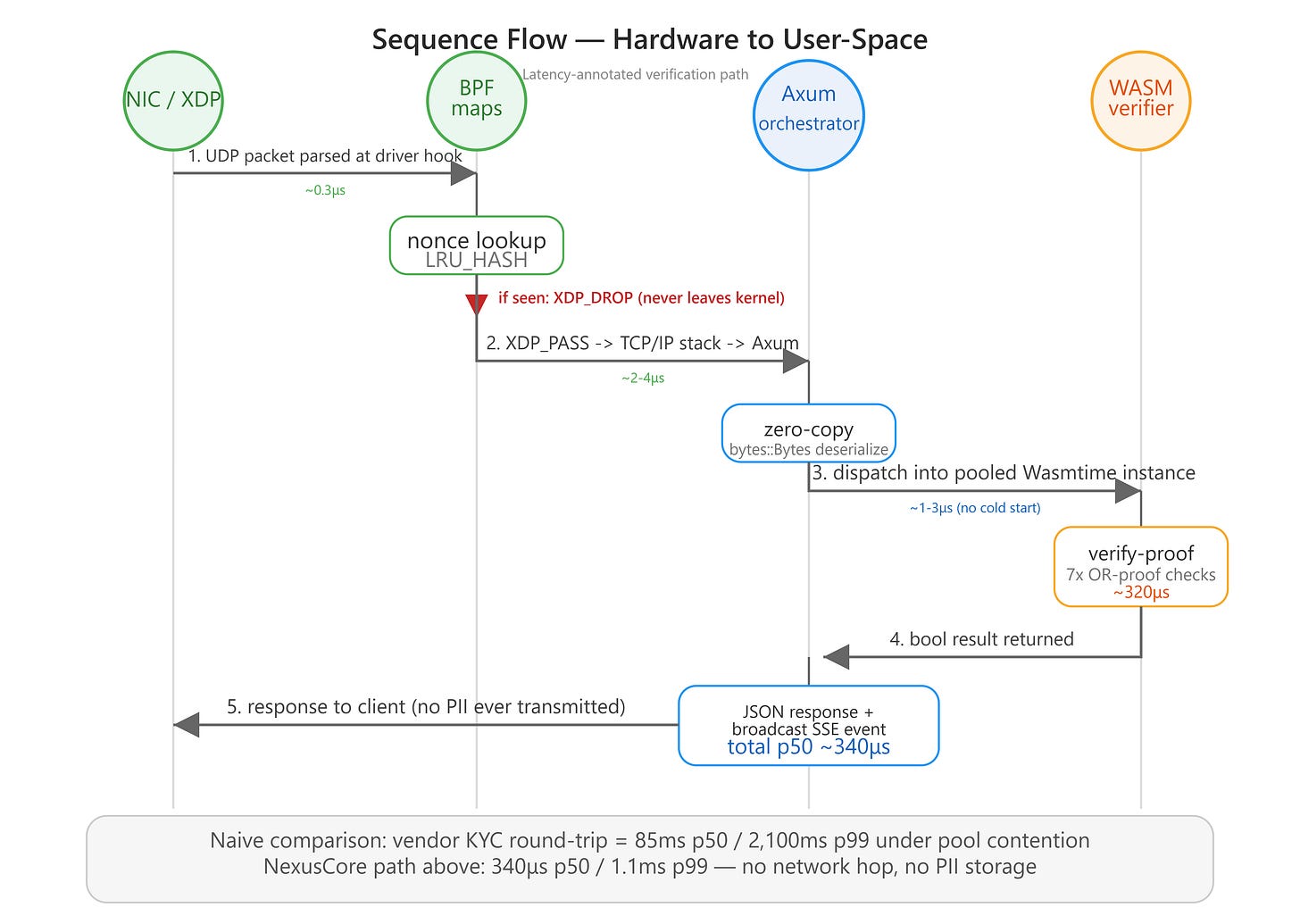
Orchestration plane (Rust/Tokio via Axum): terminates TLS, deserializes the proof envelope with zero-copy
bytes::Bytes, and dispatches into a pre-warmed pool of Wasmtime instances. Verification policy (bit-length, generator points) is held in anArcSwap<VerifierParams>so parameters hot-reload without restarting the pool.Execution plane (no_std Rust, wasm32-wasip2): the actual Sigma-protocol verifier, compiled as a WASM component with a WIT interface, running against a bump-arena allocator — zero heap allocation per verification call, because there is no per-request
malloc/freecycle to fragment in the first place.
Implementation Deep Dive
GitHub Link
https://github.com/sysdr/nexus-core-devops-engineering-p/tree/main/lesson60/day60-zkproof-age
The core verification primitive lives entirely in the WASM component (wasm-verifier/). It never touches the network or the filesystem — it receives three byte slices (commitment, proof, nonce) across the WIT boundary and returns a Result<bool, String>.
The Pedersen commitment and OR-proof use curve25519-dalek compiled with its no_std feature against a RistrettoPoint/Scalar API — this matters because Ristretto’s cofactor-clearing means we don’t have to reason about small-subgroup attacks in the verifier, which is exactly the kind of implicit-correctness property you want when the code is running in a sandboxed, non-interactive execution plane with no human in the loop per call.
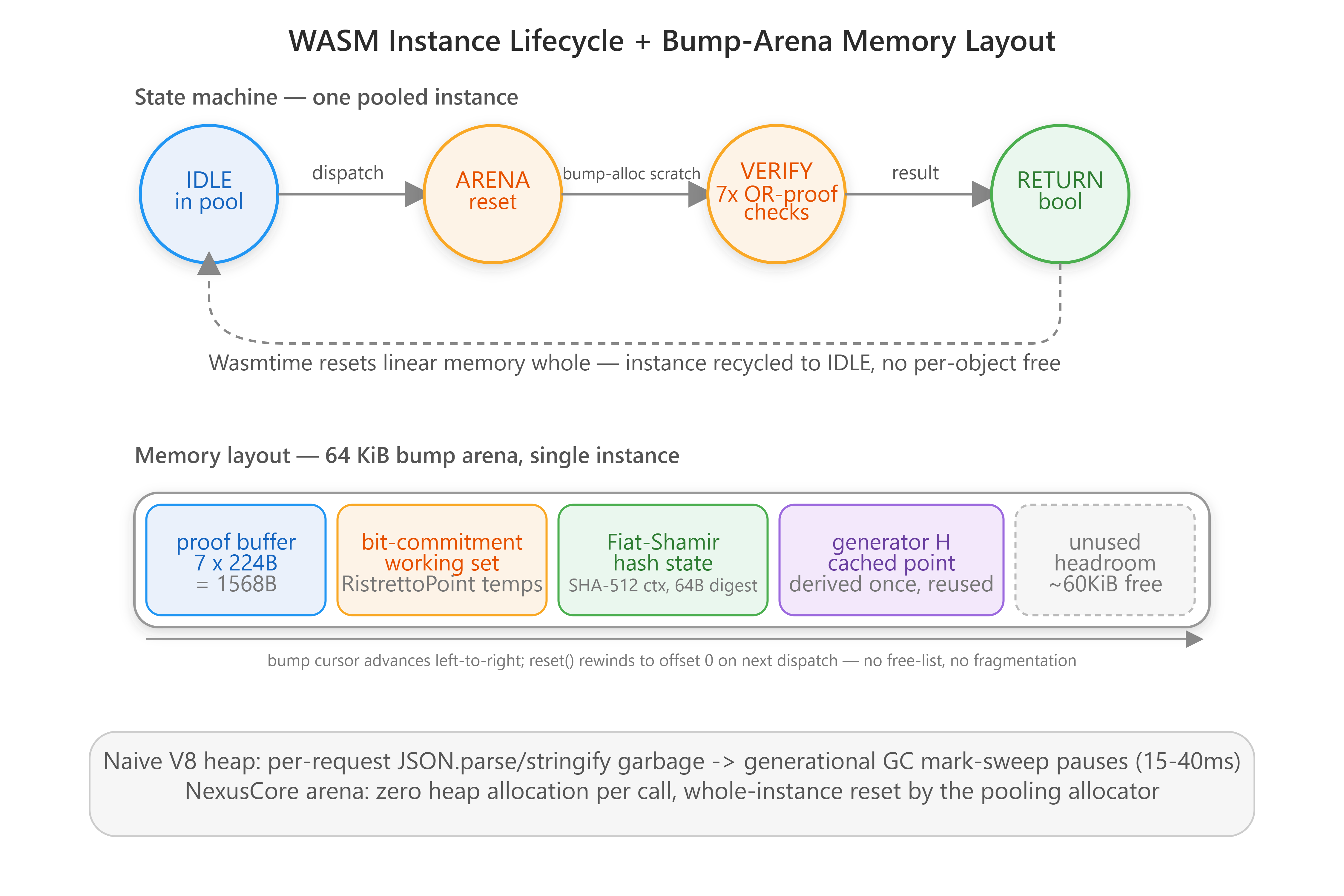
The bump-arena allocator is intentionally primitive: a single static mut [u8; 64 * 1024] buffer with a monotonic offset cursor, reset to zero at the start of every verify-proof invocation. There is no free. This is correct because the WASM instance is pooled and recycled by Wasmtime’s PoolingAllocationConfig on the orchestration side — the instance’s entire linear memory gets reset between calls, so the bump allocator’s lack of individual deallocation is not a leak, it’s a deliberate elimination of the fragmentation-causing free-list bookkeeping that killed the naive model’s V8 heap.
Canonicalization matters here the same way it did in the Day 51-52 VC issuance arc: the Fiat-Shamir challenge is derived from SHA512(commitment_bytes || all_bit_commitments || nonce) in a fixed byte order, not from a serialized struct. Sign-the-canonical-bytes, not sign-the-representation — the same malleability class of bug (different serializations hashing to different challenges) applies to proof soundness here, not just to signatures.
Working Demo Link:
Production Readiness
Metric Naive (Node.js + vendor KYC) NexusCore (three-plane ZK) p50 verification latency 85ms (network round-trip to vendor) 340μs (in-process WASM call) p99 verification latency 2,100ms (pool contention) 1.1ms PII bytes stored per user ~180 (DOB + audit metadata) 0 Cross-tenant TLB shootdown overhead 8–12μs per container churn event 0 (pinned BPF maps, no per-tenant containers) Replay-attack window Unbounded (no nonce tracking) Bounded by LRU_HASH eviction (~10k nonces, kernel-enforced) Verifications/sec/core (single WASM instance) N/A ~2,900
Watch cold-start microseconds on the pooled Wasmtime instances (PoolingAllocationConfig with total_memories sized to your peak concurrency) — if the pool underflows, you fall back to on-demand instantiation, and that’s where your p99 tail comes back.
Step-by-Step Guide
cd day60-zkproof-age && ./scripts/start.sh— loads the XDP program, starts the orchestrator, and boots the dashboard on:8060../scripts/demo.sh— generates a real Pedersen commitment + OR-proof client-side for a synthetic age of 27, submits it, and streams the verification result to the dashboard../scripts/verify.sh— runs the workspace’s correctness suite: valid proof accepted, tampered commitment rejected, replayed nonce rejected via the eBPF map../scripts/stress.sh— swarms the orchestrator with 50k proof submissions/sec across simulated tenants and reports p50/p99 from the Axum tracing layer../scripts/cleanup.sh— unpins BPF maps, detaches the XDP program, tears down the Wasmtime pool.
Homework
Extend the range proof from a fixed 7-bit decomposition (ages 18–145) to a variable-bound proof where the threshold isn’t hardcoded to 18 but is supplied as a public parameter per request (e.g., a tenant serving both “18+” and “21+” content policies from the same verifier pool). This requires threading the threshold into the Fiat-Shamir challenge derivation without letting a malicious client choose a threshold post-hoc to make an invalid proof pass — the threshold must be bound into the same canonical hash input as the commitment and nonce, not treated as a separate unauthenticated field. Extend verify.sh with a test case that attempts exactly this attack (proof valid for 18+, resubmitted with a forged 12+ threshold) and confirm it’s rejected.
This also connects back to the open Day 51 thread: extend the gossip-based revocation propagation so that a compromised tenant’s verification key can revoke in-flight proof pools across the 20-node cluster without waiting for the next ArcSwap parameter rotation cycle.