Day 49: Provenance Chains — Verifying Authorship on Retweets at Kernel Speed
NexusCore: The Autonomous Platform Architect, 2026 Edition

The Abstraction Trap
Ask a junior engineer to build “verified retweets” and you’ll get the same answer every time: a Node.js or Python microservice sitting behind an API gateway, backed by Postgres, doing this on every share event —
Pull the original tweet’s signature record from a relational table.
Fetch the author’s public key from a
userstable (or worse, a third-party KMS call).Run
crypto.verify()in userspace — usually RSA-2048 or ECDSA-P256 because “that’s what the crypto library defaults to.”Walk the retweet’s parent chain recursively in application code, one SQL query per hop.
Write the verification result back to the DB, then emit an event to Kafka for the moderation pipeline.
This works fine in a demo. It works fine at 200 requests per second. It falls over completely the moment a single tweet goes viral and you get 400,000 retweet events in ninety seconds, each one triggering a chain walk of arbitrary depth.
The framework hides three things from you: how expensive per-request TLS/crypto context setup is, how a connection-pooled ORM behaves under head-of-line blocking, and — critically — that “verify a signature” is not O(1) when your provenance model is a chain, not a flat record. The abstraction lets you ship a demo. It does not let you survive a trending topic.
The Failure Mode, Quantified
Profile the naive service under load and three mechanisms dominate the flame graph:
Connection pool exhaustion. A pool of 100 Postgres connections, each chain-walk holding a connection for the duration of N recursive queries, saturates in under 4 seconds at viral-tweet volumes. Requests start queueing on
pool.acquire(), and p99 latency goes from 8ms to 12,000ms.GIL/event-loop serialization on crypto. Even with libuv’s threadpool, Node’s
crypto.verify()for RSA-2048 costs ~0.4ms of pure CPU. At 5,000 verifications/sec that’s 2 full CPU-cores worth of work serialized behind a fixed-size threadpool (default 4), and everything else on the event loop stalls behind it.TLB shootdowns from per-tenant process isolation. Teams that “fix” the above by spinning up a verification worker process per high-volume tenant discover that every process fork/exec triggers page table invalidation across cores. At 50+ tenants doing bursty retweet traffic, you’re paying TLB shootdown IPI cost on every scale-up event, and
perf statshowsdTLB-load-missesdominating cycles that should be going to actual verification work.None of this is “the language is slow.” It’s that the architecture puts cryptographic verification and graph traversal on the same hot path as connection-pooled I/O, in a runtime that context-switches at the OS thread level for work that should never leave L2 cache.
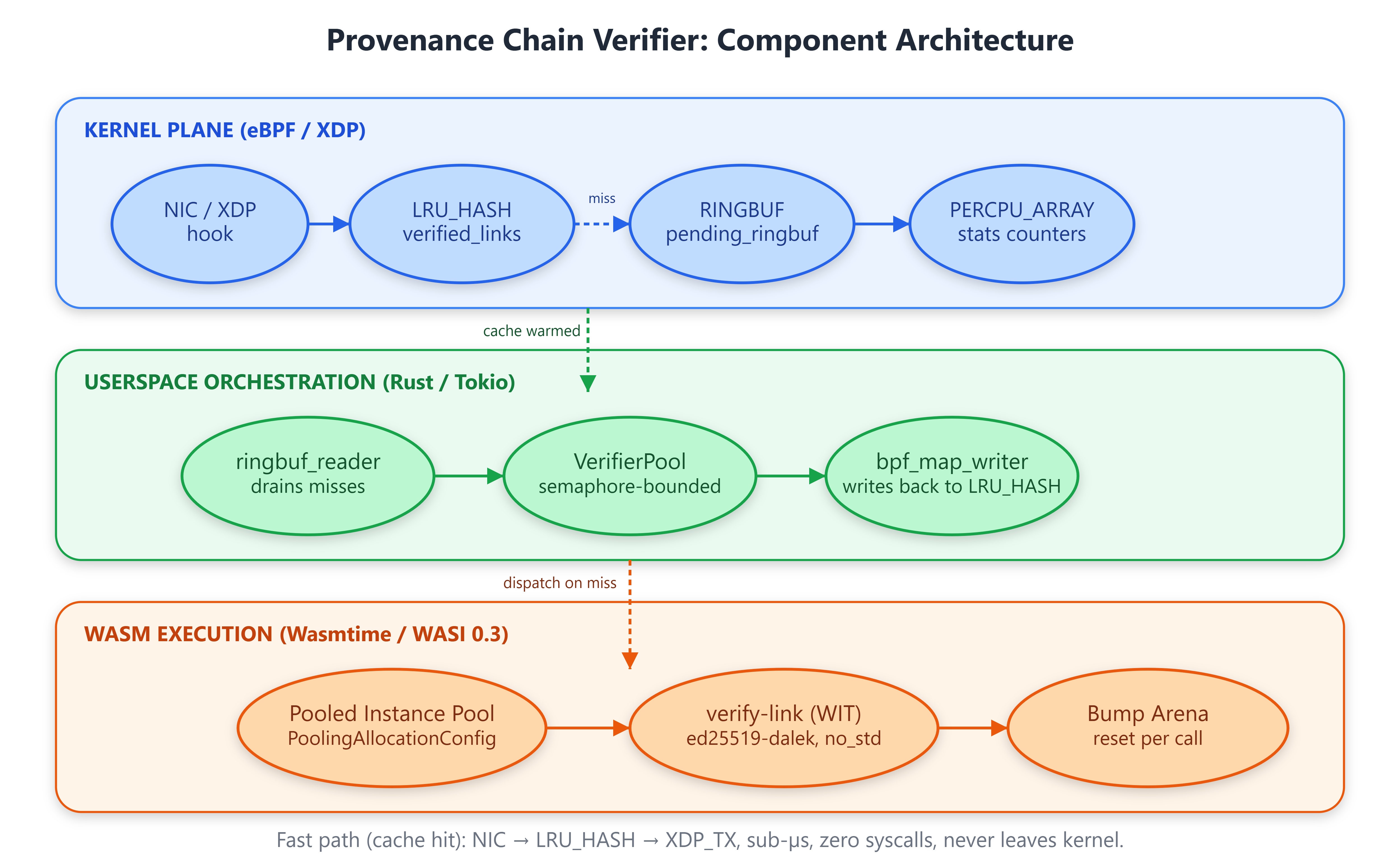
The NexusCore Architecture