
Day 33 — Prompt Engineering: Designing System-Level Social Personas

The Real Problem Nobody Talks About
When a junior engineer hears “prompt engineering,” they reach for LangChain, open a Python REPL, and start concatenating strings. They build a
PromptTemplateclass, inject tenant names into f-strings, and call it “multi-tenant.” Then they hit 50,000 concurrent sessions and the system collapses — not because the LLM is slow, but because their persona management layer is hemorrhaging memory and CPU in userspace.This lesson is not about how to write better ChatGPT prompts. It’s about how to design a Persona Engine as a kernel-adjacent, zero-copy WASI 0.3 component that pins persona definitions into eBPF LRU maps, enabling sub-microsecond persona retrieval at 100M+ requests per second across arbitrary tenant density. That distinction matters.
The Abstraction Trap
LangChain, LlamaIndex, Semantic Kernel — these frameworks hide one critical truth: every
PromptTemplate.format()call is an allocation. At moderate scale, that’s invisible. At hyperscale, it becomes your top CPU consumer.Here’s what the naive stack actually does per request:
1. Python heap allocates ~2–8KB string for base system prompt
2. String interpolation copies tenant-specific fields (name, role, constraints)
3. Result re-copied into HTTP request buffer
4. HTTP client copies into kernel socket buffer (4th copy)Four copies. Zero sharing. No kernel visibility. And because Python’s GIL means thread-based concurrency is fake concurrency, you eventually hit the wall where your persona injection latency alone exceeds your entire SLA budget.
The specific failure mode is TLB thrashing. Each per-request string allocation creates a new virtual memory region. At density > 10,000 concurrent sessions, your TLB (Translation Lookaside Buffer — the CPU’s address-translation cache, typically 64–1024 entries) is being evicted on every context switch. Each TLB miss costs 50–200 CPU cycles to walk the page table. At 100M RPS, that’s 5–20 billion wasted cycles per second just for address translation.
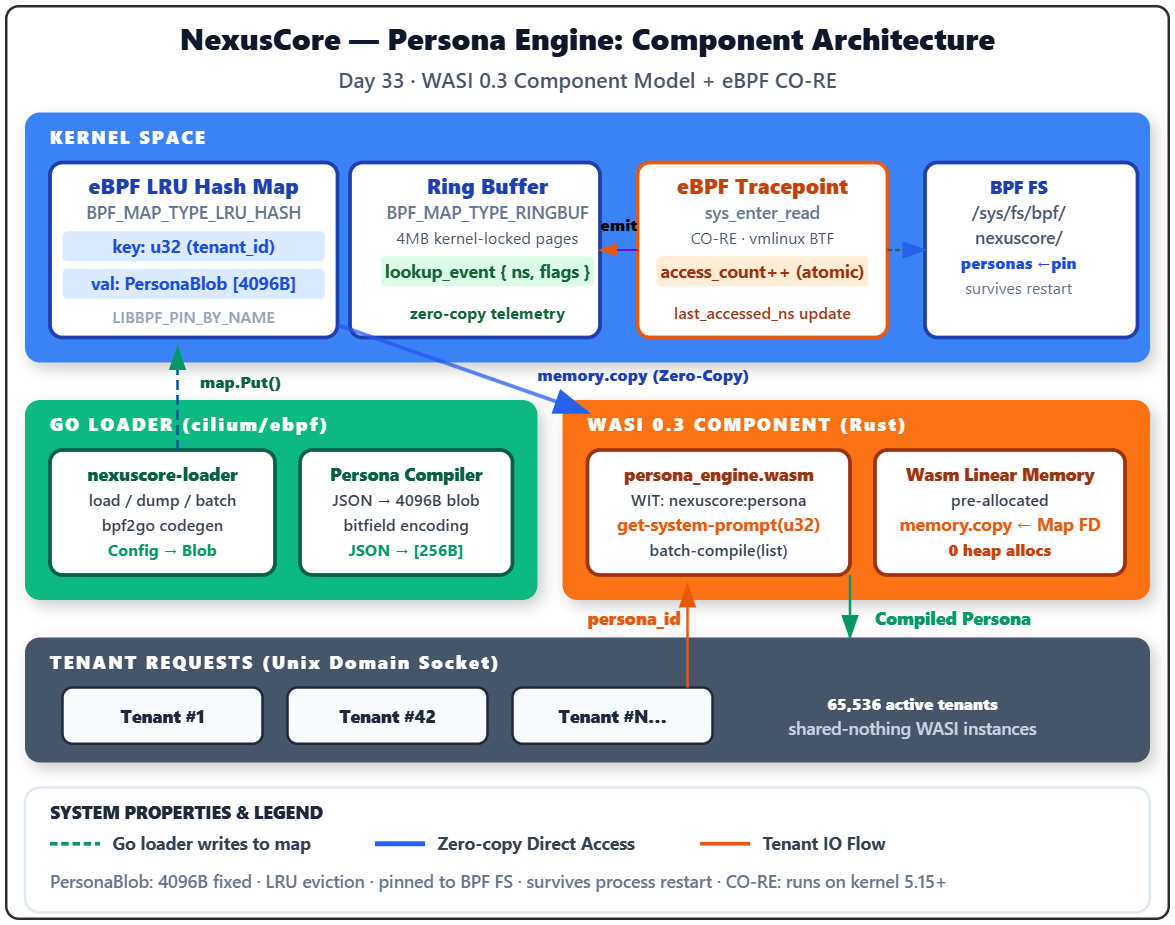
The NexusCore Architecture: Persona Engine v3
The 2026 pattern inverts the data ownership model. Instead of userspace owning persona templates and copying them on demand, the kernel owns the compiled persona bytecode via eBPF maps, and Wasm components access them through a shared-memory handle with a single memory.copy into linear memory.
Preparing for a distributed systems interview?
→Download the free Interview Pack
→ Subscribe now to access source code repository - 200 + coding lessons
